PEMF Part 2: Fatigue & Joint Pain - Could energy at a cellular level play a role?

This one is a tad longer than usual, so grab a drink, snuggle into your sofa and enjoy!
It’s no secret that I have lived with Rheumatoid Arthritis (RA) for over 20 years, and whilst I have accepted that there is at present no cure, I am always interested in learning about and investigating holistic complementary therapies to support my body and long-term well-being – naturally alongside nutrition and medical guidance.

Fatigue and joint pain are two of the most common symptoms highlighted by my clients, and are common symptoms of RA. They often occur together and can significantly impact daily life.
While nutrition plays a key role, there is growing interest in how the body’s energy systems may also influence these symptoms.
Energy at a cellular level
As explained in Part 1, every cell in the body produces energy in the form of ATP, via the mitochondria. This energy is essential for movement, repair, and normal function. When cellular energy production and metabolic balance are disrupted, it's like the voltage of the battery being drained, with research suggesting this may contribute to fatigue, reduced physical resilience, and changes in pain perception - particularly in conditions involving inflammation. And being particularly relevant in those experiencing chronic inflammatory disease, like RA.
But what is inflammation and oxidative stress?
The body naturally produces free radicals, which, when in excess (due to not enough electron-donating antioxidants being available to deactivate them) can contribute to oxidative stress and inflammation. In joints, this may influence stiffness, discomfort, and reduced mobility. Nutrition plays an important role here, particularly through antioxidant-rich foods that may help maintain balance – which is why I encourage clients to eat nutritionally balanced meals which include ‘eating the rainbow’ when it comes to fruit and vegetables, in addition to including other foods/drinks like oily fish, green tea and the use of herbs/spices like ginger, turmeric, and not forgetting extra virgin olive oil.
Exploring Pulsed Electromagnetic Field Therapy (PEMF)
Research on regular grounding (see Part 1) suggests it may support sleep, stress, and inflammation, all of which are relevant to both fatigue and joint health. As someone who loves to walk outside on grass and sand (primarily in the spring/summer) without shoes, and is known to love a gardening fix, it seemed a natural step to look further into PEMF, seeing it as another approach that focuses on the body’s electrical nature.
PEMF uses low-frequency electromagnetic pulses, similar to the earth’s natural energy, to interact with cells and tissues, aiming to support normal function. Research has explored its potential role in:
Supporting cellular energy production
Influencing inflammatory pathways
Improving circulation
Repair and recovery (incl. muscle & bone)
There has been particular interest in other musculoskeletal conditions such as osteoarthritis and chronic lower back pain, where some studies have observed improvements in pain or function. In fatigue-related conditions, including multiple sclerosis, reductions in fatigue have been reported in some cases too.
Is PEMF seen to affect RA in the research?
In RA, more than 70% of RA patients are seen to have destruction of the bone within 2 years of disease onset, with the progression of joint damage noted to be more rapid in the first year. Destruction of the joints is associated with the severity of inflammation, and so by reducing this inflammation the aim is to prevent or slow the risk of damage, support joint function and improve pain, therefore aiming to ultimately improve the individual’s quality of life. A very small scientific study looking at the impact of PEMF on pain in RA suggested it may provide a modest improvement (Shupak et al, 2006). In an animal study, using collagen-induced mice, Hong et al (2023) noted that PEMF has been associated with reducing the cartilage destruction and inflammation compared to no change in untreated mice, further supporting other findings that PEMF may have an anti-inflammatory effect and restore cell homeostasis (Selvam et al, 2007; Ross et al, 2019; Maiullari et al, 2023); supporting suggestions that PEMF may have the potential, as a complementary therapy alongside medical guidance, to suppress the progression of RA. More larger, human-based, longer-term studies are required to look into this.
My personal experience of PEMF so far…
Recently, I’ve been visiting a private PEMF clinic in the City, just near the Guildhall in London, and have now had two sessions. Before the first session, I was feeling curious. As someone living with rheumatoid arthritis, I was particularly interested to see how my body might respond, but if I am honest, I had no real idea what to expect.
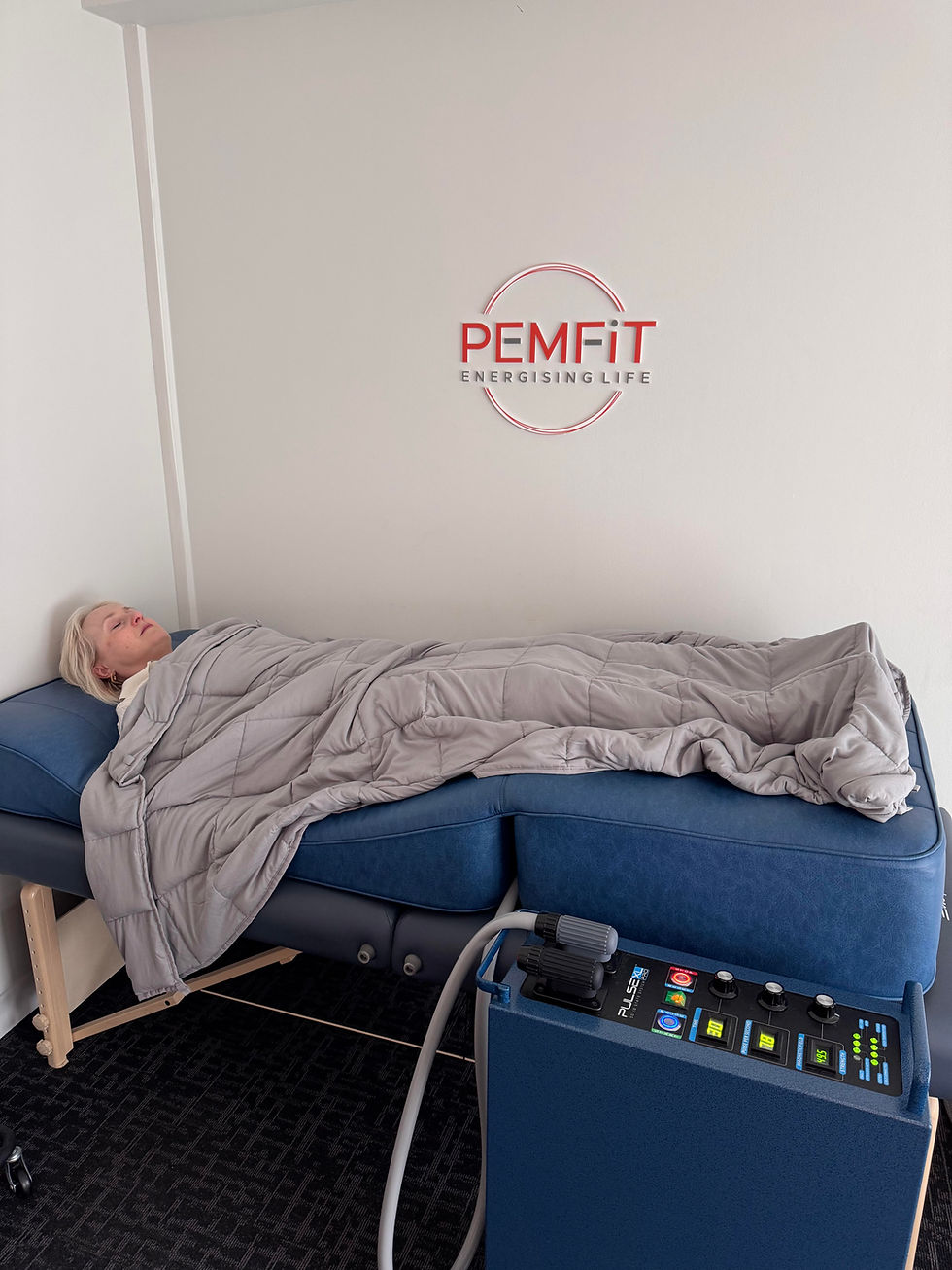
The clinic setup itself was very relaxing – like a spa. You lie fully clothed on a treatment bed, just removing things like a smartwatch, and I was tucked under a weighted blanket, which made it feel instantly cosy.
So what does it feel like?
I’ll be honest - at first, I did not feel anything at all, just the gentle hum of the machine in the background. Then, as the frequency was gradually increased, I started to notice a light tapping sensation in my shoulder, then my arm and hip.
The best way I can describe it is like a child gently prodding you to get your attention. Not uncomfortable in any way, actually, it’s quite soothing. Before long, I felt deeply relaxed and surprisingly sleepy. It became quite difficult to keep my eyes open or stay focused on my conversation with the therapist. Noticing this, she quietly left me to rest, checking in occasionally while I drifted in and out of that in-between state of relaxation and sleep. As the session came to an end, the frequency was slowly reduced until the gentle humming stopped completely.
And afterwards?
I felt calm, light, and noticeably happy, something my daughter was very quick to point out over the following week. Apparently, I was so cheerful she felt she could get away with anything… hmm. I also slept really well that night.
The second session felt particularly interesting. In the lead-up, I had been experiencing some stiffness in my hands, and there was a question in my mind as to whether a flare might be developing. As I walked into the clinic I felt my body start to relax even before I had even got onto the bed – like a reflex action.

Afterwards, I felt as though I had had a really deep sleep, slightly groggy at first, but once that lifted, I was left with a sense of calm, steady energy. Not the jittery kind, but the sort that makes you feel quietly capable and ready to take on whatever the day brings, including Easter weekend logistics.
Over the following days, I continued to sleep deeply and found myself feeling more relaxed overall. I also noticed I was thirstier than usual, which felt like a gentle reminder to stay well hydrated and was in line with the pre-treatment guidance to support detoxification. Around 48 hours later, the swelling in my fingers had settled, and I felt more like myself again, calm, energised, and positive, even despite the grey and rainy weather.
The clinic recommends a series of regular sessions to support longer-term effects, in line with the research and studies reviewed, so I’m planning to book further sessions in due course.
We are all unique
Of course, this is just my personal experience, and responses can vary from person to person. One thing I found particularly interesting was how individual the treatment is. During my session, a higher frequency was used (7.83 Hz in line with the Earth’s frequency), but this is not about ‘more being better’. It’s about how your body responds. My therapist explained that some people feel very little in their first session, and then notice a much stronger response the second time. Others may respond immediately.
I guess it’s a helpful reminder that when it comes to complementary therapies and personal wellbeing, there is no one-size-fits-all approach, and tuning into your own body is key.
A balanced perspective
While this area of research is promising, it is still developing. Responses vary, and PEMF should be viewed as a complementary approach rather than a standalone solution.
Nutrition, sleep, stress management, and movement remain key foundations.
Final thoughts
Fatigue and joint pain are complex and often multifactorial, but looking at other aspects, such as the body’s energy systems, offers a broader perspective on how we might support health and wellbeing.
Simple practices like spending time outdoors and reconnecting with nature are good habits to have generally. But when you are not able to do this or have a chronic condition, it's good to know that there are other emerging complementary therapies which may provide additional tools to support your body and wellbeing.
Sometimes, small shifts can make a meaningful difference.
If you are experiencing fatigue and/or joint pain and would like to investigate the root cause and support your wellbeing, or are interested in understanding more about PEMF, then don’t hesitate to contact me via the Contact tab above or book a free no-obligation 20-minute call with me.

References:
Hong, J.E. et al. (2023) “Pulsed Electromagnetic Field (PEMF) Treatment Ameliorates Murine Model of Collagen-Induced Arthritis,” International Journal of Molecular Sciences, 24(2). Available at: https://doi.org/10.3390/ijms24021137.
Koniver, L. (2023) “Practical applications of grounding to support health,” Biomedical Journal. Elsevier B.V., pp. 41–47. Available at: https://doi.org/10.1016/j.bj.2022.12.001.
Maiullari, S. et al. (2023) “Pulsed Electromagnetic Fields Induce Skeletal Muscle Cell Repair by Sustaining the Expression of Proteins Involved in the Response to Cellular Damage and Oxidative Stress,” International Journal of Molecular Sciences, 24(23). Available at: https://doi.org/10.3390/ijms242316631.
Menigoz, W. et al. (2020) “Integrative and lifestyle medicine strategies should include Earthing (grounding): Review of research evidence and clinical observations,” Explore. Elsevier Inc., pp. 152–160. Available at: https://doi.org/10.1016/j.explore.2019.10.005.
Oschman, J.L., Chevalier, G. and Brown, R. (2015) “The effects of grounding (earthing) on inflammation, the immune response, wound healing, and prevention and treatment of chronic inflammatory and autoimmune diseases,” Journal of Inflammation Research, 8, pp. 83–96. Available at: https://doi.org/10.2147/JIR.S69656.
Ross, C.L., Ang, D.C. and Almeida-Porada, G. (2019) “Targeting mesenchymal stromal cells/pericytes (MSCs) with pulsed electromagnetic field (PEMF) has the potential to treat rheumatoid arthritis,” Frontiers in Immunology. Frontiers Media S.A. Available at: https://doi.org/10.3389/fimmu.2019.00266.
Selvam, R. et al. (2007) “Low frequency and low intensity pulsed electromagnetic field exerts its antiinflammatory effect through restoration of plasma membrane calcium ATPase activity,” Life Sciences, 80(26), pp. 2403–2410. Available at: https://doi.org/10.1016/j.lfs.2007.03.019.
Shupak, N.M. et al. (2006) “Exposure to a specific pulsed low-frequency magnetic field: A double-blind placebo-controlled study of effects on pain ratings in rheumatoid arthritis and fibromyalgia patients,” Pain Research and Management, 11(2), pp. 85–90. Available at: https://doi.org/10.1155/2006/842162.
World Health Organisation. (2023) "Rheumatoid Arthritis". Available at: https://www.who.int/news-room/fact-sheets/detail/Rheumatoid-arthritis



Comments